
In finance, everyone says they are chasing alpha. Most are really chasing attention. Hedge funds, asset managers, and brokers compete to be the loudest across podcasts, TV panels, and press releases, packaging ambition as insight and self-promotion as expertise. Quattroporte takes a different approach. We believe in disciplined execution, dependable delivery, and results that speak for themselves. Quietly.
Quiet Alpha is the opposite
It emerges when a strategy consistently outperforms the market without attracting massive attention or huge inflows of capital.
No big announcements. No interviews about our genius edge.
Just quiet, methodical outperformance. Year after year.
Many active strategies claim to generate alpha. But when you strip away risk, luck, and factor exposure, what often remains is mediocre results—sometimes even worse than the index after fees. And those who actually succeed often become victims of their own success. When too much capital chases the same ideas, the edge disappears.
It’s a bit like when a small restaurant suddenly becomes trendy. Once the line stretches around the block, the food is rarely as good anymore.
Too good to be true?
Since 2016, Quattroporte has run its own portfolio, guided solely by signals from our Q-Ball system. The portfolio has beaten OMXS30 every single year, including during more turbulent periods such as the COVID year 2020 and 2022 when Russia invaded Ukraine.
Does it sound too good to be true?
Then it’s better to show the data straight from Avanza’s system.
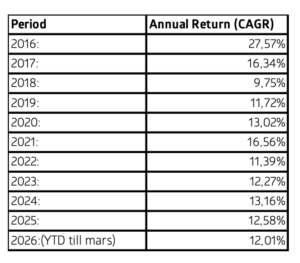
Our portfolio has delivered a total return of +245.37% since July 2016—while OMXS30 Total Return grew +101.07% over the same period.
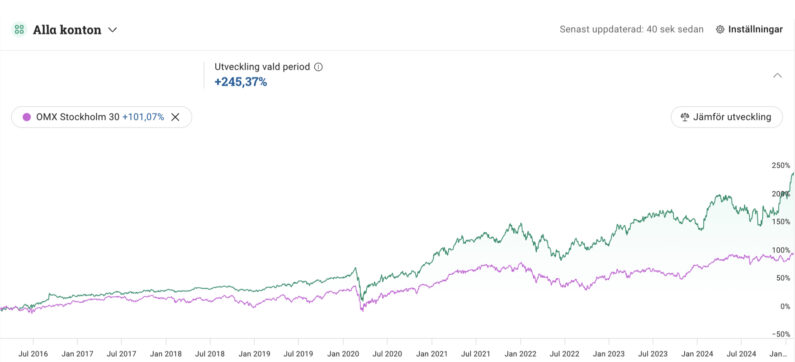
The curve is also stable, with significantly smaller drawdowns than the index. A rough estimate places the Sharpe ratio in the range of 0.8 to 1.2 over a multi-year period, indicating that the returns have not only been strong but also robust on a risk-adjusted basis. In other words, the curve is stable, with considerably smaller drawdowns than the index.
The portfolio typically consists of 15–25 stocks, with rebalancing approximately every quarter.
None of us has a traditional finance education. The goal has never been to get rich quick, but to validate the model in a real-world environment.
We don’t have hundreds of GPUs in the basement. And of course, we have no insider information.
So what drives the results? Naturally, it’s our AI system Q-Ball.
Q-Ball
The system analyzes vast flows of information to capture expectations and trend shifts long before they become visible in macro data, surveys, or even social media. After all, markets don’t just react to what’s happening today. They react to what people believe will happen tomorrow.
Some telling examples:
- Consumption: The luxury segment. As early as around 2010, Q-Ball saw that demand for premium- and luxury brands would grow strongly over the coming decade. Hermès and a few other companies in the segment therefore became early candidates in our analyses.
- Technology: In the same way, the system identified artificial intelligence as a transformative force long before AI became a daily topic of conversation.
- Society/politics:
- Q-Ball indicated as early as 2015 that Donald Trump had a real chance of winning the U.S. presidential election—at a time when that conclusion was far from popular. We repeated this ahead of his subsequent campaigns as well.
- The system also picked up on Brexit, as well as the rise of populist currents in the Western world, such as growing nationalist forces.
- As early as 2012, we could see signs that Russia was developing in a more aggressive direction—an analysis that was met with great skepticism at the time.
Right now, we are also using the system to analyze developments related to the conflict between Iran and Israel—something I will return to in a forthcoming article.
This doesn’t mean Q-Ball is always right. But in enough cases, the system has seen the direction earlier than others.
Next Step
Now we are taking the next step.
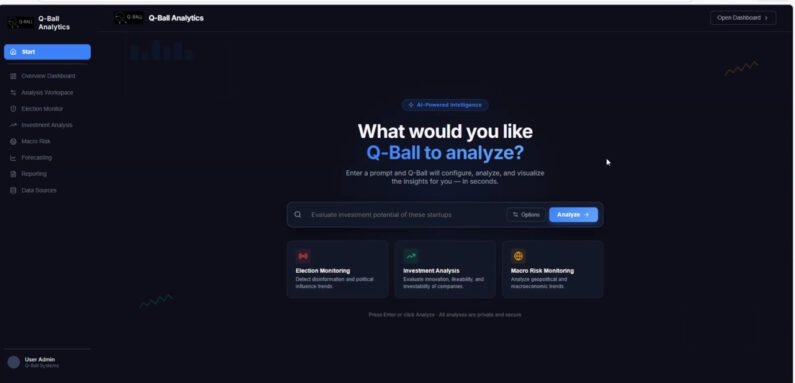
Q-Ball has long been an internal analysis engine in our consulting assignments. Now we are developing a more user-friendly interface so that professional users can work with the system themselves—without consultant support.
The interface will align with platforms like Palantir, Tableau, and Microsoft Power BI, becoming a tool where users can intuitively analyze signals in geopolitics, technology, culture, consumption, and societal change.
As mentioned above, Q-Ball is not only relevant for the financial market. The same logic can be used by governments, companies, and other organizations that need to understand changes early, identify risks, and make better decisions under uncertainty.
We have used Q-Ball to analyze everything from design trends, retail, and real estate to democracy development, energy, and travel.
A Bloomberg for trends
But with a focus on future changes, not just historical data.
The ambition is to provide investors, companies, authorities, and other decision-makers with a tool to discover opportunities, understand risks, and act earlier than the broader market. A tool that anyone can use without special prior knowledge.
Quiet Alpha has operated quietly for nearly a decade. Now it’s becoming a little less quiet.
We will launch during 2026.
Are you interested in testing the new version of Q-Ball? ¨
Contact me, Peter Majanen, at peter.majanen@quattroporte.se I’d be happy to tell you more.